



Hyundai’s Fuel-Efficient Lineup- Driving Toward a Greener Future
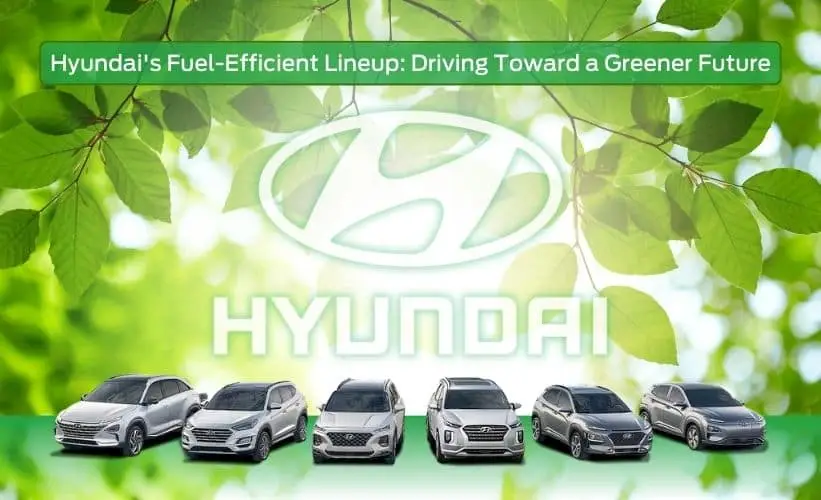
Hyundai’s Fuel-Efficient Lineup: Driving Toward a Greener Future
Hyundai’s reputation for producing quality, dependable, tech-forward vehicles is well known and undisputed.
The automaker also recently received a different sort of accolade: recognition as an industry leader in fuel economy and reduced greenhouse gas emissions.
The Environmental Protection Agency’s (EPA’s) 2023 Automotive Trends Report – one of the industry’s most recognized studies for greenhouse gas emissions and fuel economy – found that Hyundai was second only to a noted all-electric automaker for highest fuel economy and lowest CO2 emissions of any mainstream automaker.
According to the report, detailed in a Hyundai Motor America press release, between 2017 and 2022, the company reduced its CO2 emissions from 311 g/mi to 302 g/mi. Hyundai also improved its real-world fuel economy from 28.6 to 29.1 MPG over the same period.
Those numbers are significant. They’re important to the auto industry in the long run and underscore Hyundai’s ongoing commitment to sustainability and a greener future.
If you strive to be an environmentally responsible vehicle owner, visit your local Hyundai dealership. We love to talk about fuel efficiency and “green” vehicles – and, of course, we are happy to answer any questions you may have.
First, a couple of definitions
What are fuel efficiency and fuel economy? Both are ways to measure your vehicle’s fuel consumption.
Fuel economy is simple because it’s a specific number – in North America it’s MPG or miles per gallon. (Many other nations express the concept as kilometers per liter.) Automakers and dealers put the MPGs on the sticker and in advertising, allowing consumers to easily compare one vehicle to another.
Fuel efficiency is about fuel consumption performance, which can be affected by numerous factors, including engine size, configuration (including number of cylinders), vehicle weight and type of fuel.
Diesel fuel, for instance, has greater energy density and diesel engines have a higher compression ratio within the cylinders, making diesel engines markedly more efficient than their gasoline counterparts.
Drivetrain is another example – four-wheel-drive vehicles are less efficient than two-wheel-drives because the engine has to send power to more wheels, which requires more fuel. Among 2WD vehicles, front-wheel drive is more efficient than rear-wheel drive for front-engine cars.
Drivers also play a role in fuel efficiency. Want to improve your vehicle’s performance? Here are some tips:
- Maintain your vehicle. Change the oil and filters on time. Replace the spark plugs when necessary. A well-maintained vehicle performs better, lasts longer and is more efficient.
- Pay attention to tires. Make sure your tires are correctly inflated. Check your wheel alignment. Replace tires when they wear out or develop problems. These tips can reduce the amount of drag on your engine.
- Don’t overload your vehicle. Extra weight in the trunk or on the roof rack can have a negative effect on fuel efficiency and economy.
Choosing a green Hyundai, no matter what color it is
Hyundai’s plan for an all-electric lineup takes nothing away from its commitment to fuel economy and efficiency for current gas-powered and hybrid vehicles.
Let’s look at the ones that top the list.
2023 Elantra hybrid: This popular sedan is way out in front of the pack with up to 56 mpg on the highway. The EPA’s estimate for combined city/highway driving is 50 to 54 mpg, depending on the trim.
Edmunds calls it “smooth, exceptionally fuel-efficient and feature-packed” as well as “excellent value for the money.”
The Blue (base) trim offers a 1.6-liter GDI 4-cylinder hybrid powertrain, blind-spot collision avoidance system, heated front seats, hands-free trunk release and Bluelink® Connected Car System. Starting MSRP is $24,550.
Quick comparison:
- 2024 Elantra: 41 mpg highway, 36 combined. 147 horsepower 2-liter, 4-cyinder gas-powered engine. MSRP for SE (base) trim: $21,625.
- 2023 Elantra N: high-performance sports sedan. 31 mpg highway, 25 combined. 2-liter turbo GDI 4-cylinder gas-powered engine. MSRP $32,900.
2023 Sonata Hybrid: Popular and eye-catching, the Sonata hybrid is close behind the Elantra with 54 mpg on the highway and an EPA-estimated 52 mpg combined. It shares many features with the Elantra but also offers a 192-horsepower hybrid engine and forward collision-avoidance assist with pedestrian detection.
MotorTrend says driving the hybrid feels like the gas-powered Sonata and is a “worthy hybrid sedan” that commuters could appreciate. MSRP for the Blue (base) trim is $28,450.
Quick comparison:
- 2024 Sonata: up to 36 mpg on the highway, 29 combined in the base trim FWD version. 191 horsepower, 2.5-liter MPI/GDI 4-cylinder gas engine. MSRP for SEL (Base) trim: $27,500.
2024 Tucson hybrid: This snappy, all-purpose hybrid gets up to 38 mpg on the highway and 37 when city driving is figured in. The SEL Convenience (base) trim comes with HTRAC all-wheel drive standard and Hyundai’s e-handling technology that, combined with the traction control system and hybrid electric motor, delivers tight cornering performance. Power comes from a 1.6-liter turbo engine and hybrid electric motor.
Edmunds praised the vehicle’s refined powertrain, strong acceleration, roomy interior and superior tech features.
MSRP for the SEL Convenience trim is $34,905.
Quick comparison:
- 2024 Plug-in hybrid: up to 35 mpg combined; 33 miles all-electric range. 261 horsepower combined electric/gas. MSRP in SEL (base) trim: $38,475.
- 2024 gas-powered Tucson: up to 32 mpg highway, 28 combined in SEL (base) trim FWD version. 187-horsepower 2.5-liter GDI/MPI 4-cylinder engine. MSRP for SEL (base) trim: $29,650.
2023 Santa Fe hybrid: This SUV for the family that likes adventure racks up 36 mpg in the city and 34 combined. The 1.6-liter turbo GDI 4-cylinder engine paired with a 44.2kilowatt electric motor cranks out an impressive 226 horsepower. Features include HTRAC all-wheel drive and blind-spot collision-avoidance assistance.
MotorTrend gave it a thumbs-up for its roomy interior, abundance of tech and driver-assist features and its ability to go 500 miles between fill-ups.
MSRP for the Blue (base) trim is $36,210.
Quick comparison:
- 2023 Santa Fe plug-in hybrid: up to 33 mpg combined; 30 miles all-electric range. 261 horsepower combined electric/gas. MSRP in SEL Convenience (base) trim: $42,410.
- 2024 gas-powered Santa Fe: up to 28 mpg highway, 26 in FWD version. Up to 281 horsepower. 2.5-liter Smartstream GDI/MPI 4-cylinder engine. MSRP for XRT (base) trim: $34,250.
2024 Kona: Full-size SUV. Up to 35 mpg highway in FWD version. 147-horsepower 2-liter MPI 4-cylinder engine. MSRP for SEL (base) trim: $25,600. Also available in all-electric version.
2024 Venue: Entry-level SUV. Up to 33 mpg highway. 121-horsepower DPI 4-cylinder gas engine. MSRP for SE (base) trim: $19,900.
2024 Santa Cruz: Sport adventure vehicle. Up to 27 mpg on the highway. 281 horsepower 2.5-liter turbocharged GDI-MPI 4-cylinder gas engine. MSRP for Night (base) trim: $38,460.
2024 Palisade: Three-row upscale SUV. Up to 26 mpg highway in FWD version. 291 horsepower 3.8-liter GDI V6 gas engine. MSRP for XRT (base) trim: $41,800.
Go green with Hyundai!
If you want to increase performance and decrease your carbon footprint, look for a vehicle – we suggest a Hyundai – that’s fuel efficient.
The team at your local Hyundai dealership can answer your questions and help you find a fuel-efficient, planet-friendly sedan or SUV that’s right for you. Schedule a test drive today and see how far a fuel-efficient Hyundai can take you.
0 comment(s) so far on Hyundai’s Fuel-Efficient Lineup- Driving Toward a Greener Future